Five Players I'm Drafting Above Their ADP
Every draft board is a set of opinions that happened to average out. Consensus rankings are useful, but they lag role changes, they anchor hard to last season’s box score, and they smooth over the reasons a player’s number moved.
These are five players I have ranked higher than consensus does. Four of them are not market inefficiencies. The draft room and the expert consensus mostly agree on these guys, and I disagree with both. The case for each one is the usage, the efficiency, and the role change underneath the ranking, not the ranking itself.
Listed in ADP order, so this reads the way a draft does.
Travis Etienne Jr., RB, NO
He’s rated RB18 coming off an RB10 season.
New Orleans is a young offense, but the offensive line is strong and still developing, which is the kind of situation where a back’s floor rises through the season rather than falling.
He’s excellent in the receiving game, 89th percentile in receiving yards last year. That’s what makes him matchup proof. Game script stops mattering as much when a back catches passes.
74th percentile in yards after contact and 75th percentile in average time to line of scrimmage. He’s decisive getting downhill and he’s finishing runs.
He’s a three down back in a Kellen Moore offense, and he’s going to be a workhorse. Even if the 4.3 yards per carry doesn’t move much, the volume and the receiving work put him back inside the top 12.
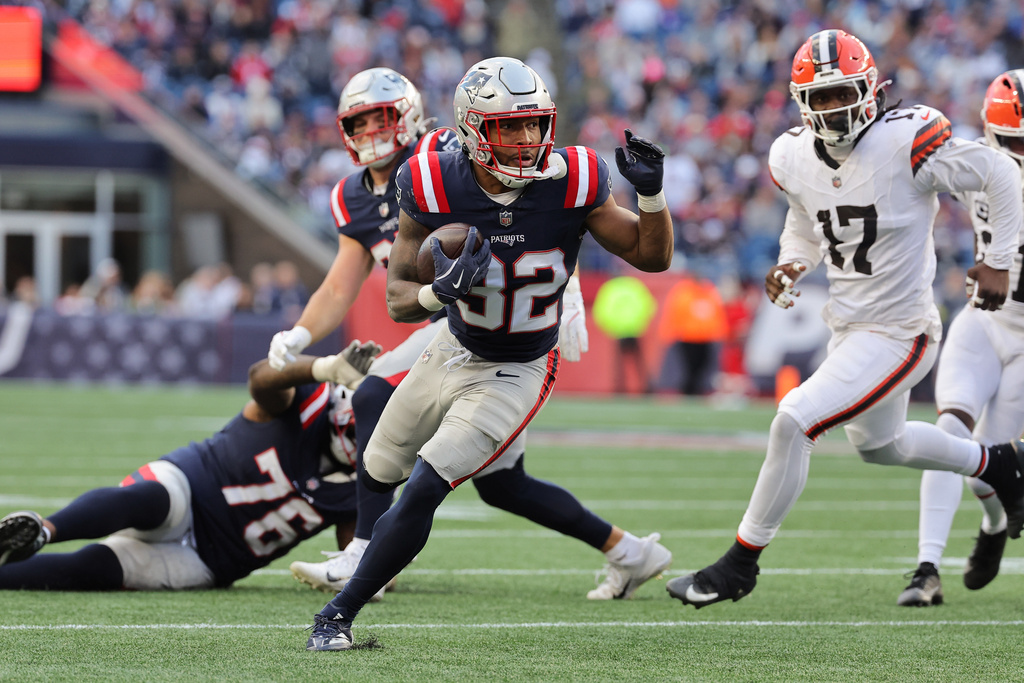
TreVeyon Henderson, RB, NE
Consensus has him as RB24. He finished RB21 last year on 10.5 carries a game.
That’s the case in two sentences. He produced top 21 numbers as a rookie on a part time workload, and everything pointing at 2026 says the workload grows. Stevenson is still there, but a committee where Henderson takes the bigger half looks very different from what he had last year.
The efficiency backs it up. 5.1 yards per carry, 35 catches in limited time, 10 touchdowns. Rookie backs don’t usually hit all three.
Two numbers that hold up under pressure: 7.7 yards per carry on end gap runs, and 6.4 against a heavy box. The second one matters more. Loaded boxes are where volume backs get exposed, and he was still gaining six and a half.
The line is better. The offense is more dynamic. And that 85th percentile mark in rush yards over expected says the production wasn’t scheme or blocking doing the work for him.
You’re drafting the RB24 price on a back who already produced like RB21 with less.
DJ Moore, WR, BUF
He’s being drafted as WR26, coming off a WR35 season where he saw 85 targets, the second fewest of his career. The volume left, so the production left.
Now he’s in Buffalo as Josh Allen’s WR1 in a dynamic Joe Brady offense. Brady coached him in Carolina the year he first cleared 1,000 yards.
He wins at every level. 200 or more yards at every pass depth, so this isn’t a player who only works underneath or only on go routes.
77th percentile in average YAC alongside that separation mark. Still getting open, still creating after the catch.
The whole case is volume. His history is clear: at 7 or more targets a game he finishes WR20 or better, and at 8 or more that becomes WR15. In this offense he’s clearly the best receiver on the field.
You’re paying WR26 for the first read in a Josh Allen passing game.
Josh Downs, WR, IND
He’s WR42, coming off a WR44 season on a crowded offense.
That crowd is gone. With Michael Pittman Jr. traded, Downs is the full time slot receiver and steps into the two receiver sets he was rotating out of last year. Snap share is the cheapest way for a young receiver to jump, and his just went up without him doing anything.
He dominates on the post and the hitch, both staples in this offense. That matters more than it sounds. Route level strength that matches what the offense already runs turns into targets rather than sitting unused.
His best work came on third down, which is a real signal for a young receiver. Third down targets go to players the quarterback trusts, and that trust usually precedes a volume jump.
He scored four times last year. With the target share coming his way, that number has room to move.
Jayden Higgins, WR, HOU
He’s WR50, coming off a WR47 season on 68 total targets. That’s a top 50 finish on almost no volume.
He’s on pace to be the Texans’ WR2 in Week 1.
The physical profile is the part you can’t teach. 6’4” with real speed, and he averaged 12.8 yards per catch as a rookie. Big receivers who move like that get targeted in the areas that produce points.
The post is a big play route, and a tall receiver who wins there is a weekly ceiling raiser rather than a floor play.
He also dominated zone coverage as a rookie, which is the coverage young receivers usually struggle against. Beating zone means he’s reading it correctly, not just winning on athleticism.
WR50 for a receiver about to start opposite Nico Collins with that route profile is a price worth taking.
How to use this
None of these are free money. A player going later than I have him ranked can mean the room is wrong, or it can mean the room absorbed something the rankings haven’t caught up to yet. Camp news moves faster than consensus in late July.
What I’d take from this is the reasoning rather than the names. Role changes, target share shifts, and efficiency that held up in bad situations are the things that move a player before the ranking does.
class="tool-link" href=/redraft-rankings target= rel= >